

 0
0
 0
0
The Next Frontier Is Light
For more than half a century, computing has advanced according to a familiar formula: make electronic components smaller, faster, and more efficient. From room-sized machines to powerful devices that fit in our pockets, the semiconductor industry has transformed modern life. But as conventional silicon technology encounters increasingly complex physical and engineering challenges, a fundamental question is emerging: What comes after the electronic chip?
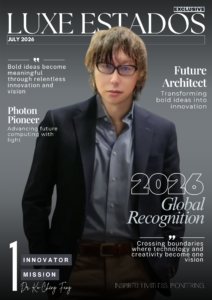
For Dr. Ko-Cheng Fang, Founder and CEO of LongServing Technology, the answer may lie not in making electronics smaller, but in changing the way information moves altogether.
His vision is centered on photonic computing—a computing approach in which light, rather than electrical signals alone, becomes central to the movement and processing of information. In April 2026, LongServing Technology publicly unveiled a detailed architectural concept for its proprietary photonic chip, providing a closer look at how Dr. Fang believes computing could evolve beyond conventional electronic pathways.

The unveiling presented three major technical designs: a proposed photonic pathway architecture, a three-dimensional structural layout, and a photonic full-adder chip. Together, the diagrams represent the company’s clearest public presentation yet of an architecture built around optical information processing.
From Electrons to Photons
Traditional computer chips depend on electrical signals moving through metallic interconnects. As processors become increasingly sophisticated, however, the movement of data itself can become a major limitation. Processing power may continue to increase, but transferring information between different parts of a system requires energy and time.
Photonic computing approaches the problem differently.
Instead of relying primarily on electrons to transport information, optical systems use photons—the fundamental particles associated with light. Photons can carry information rapidly through optical pathways, creating opportunities for high-bandwidth data movement and potentially reducing some of the limitations associated with electrical interconnects.
LongServing Technology’s architecture takes this concept further by attempting to build computation, memory, and optical communication into an integrated environment.
At the heart of the company’s design is an unusual 45-degree optical pathway architecture. Rather than following conventional horizontal routing patterns, the proposed optical channels use diagonal configurations intended to guide light efficiently throughout the chip.
For Dr. Fang, this is more than a change in geometry. It represents a different philosophy for designing computing hardware—one in which the movement of light becomes a fundamental architectural consideration.
A Three-Layer Vision

Another defining feature of LongServing Technology’s proposal is its three-layer structure.
The bottom layer is designed around integrated photonic memory, providing a location for optical data storage. Above it sits the middle layer, where photonic logic gates perform computational operations. The top layer contains dedicated photonic pathways intended to transport optical signals throughout the processor.
According to the company, each layer would be produced using its own dedicated photomask.
This arrangement seeks to bring memory and computation closer together, addressing one of computing architecture’s longstanding challenges: the distance between where data is stored and where it is processed.
In conventional systems, processors frequently move information back and forth between memory and computational units. This movement contributes to what engineers commonly call the “memory wall,” where the increasing speed of processors is constrained by the ability to supply them with data.
By integrating photonic memory directly into the computational architecture, LongServing Technology aims to minimize unnecessary data movement.
Building Computation With Light

Perhaps the most symbolic element of the unveiling is the company’s photonic full-adder design.
A full adder is a fundamental digital logic component used to perform binary addition. Although simple compared with a modern processor, full adders are building blocks for more complex arithmetic circuits.
Demonstrating how such a function could be implemented using photonic circuitry provides a conceptual bridge between individual optical components and larger computing architectures.
The objective is not simply to demonstrate that light can travel through a chip. It is to explore whether computation itself can increasingly take place within an optical environment.
A New Era of Possibility
LongServing Technology has made ambitious projections regarding the potential performance of its architecture, including claims of computational capabilities potentially hundreds of thousands of times greater than conventional electronic chips. Such projections remain company estimates and would require substantial engineering development, fabrication, benchmarking, and independent validation before they could be established as real-world performance results.
That distinction is important because photonic computing, like every emerging technology, faces significant technical challenges. Manufacturing precision, optical losses, memory implementation, thermal management, integration, software compatibility, and large-scale fabrication all remain important considerations.
Yet innovation often begins with a willingness to question established assumptions.
Dr. Fang’s approach asks whether the next generation of computing should continue to revolve around increasingly complex electronic pathways—or whether the architecture itself should evolve around the extraordinary properties of light.
The Future, Reimagined
The demand for computing power is accelerating across artificial intelligence, scientific research, high-performance computing, advanced simulation, and data-center infrastructure. Meeting that demand may require more than incremental improvements to existing technologies.
Photonic computing is one of several emerging approaches being explored alongside quantum computing, neuromorphic architectures, advanced semiconductor packaging, and other unconventional technologies. None represents a guaranteed replacement for conventional computing. Each addresses different challenges and carries its own engineering obstacles.
Within this rapidly changing landscape, Dr. Ko-Cheng Fang’s work offers a distinctive proposition: rethink the architecture before simply improving the components.
The April 2026 unveiling of LongServing Technology’s photonic pathway, three-dimensional architecture, and full-adder concept gives the public a window into that proposition.
Whether these designs ultimately become commercially manufactured processors will depend on the next stages of research, engineering, fabrication, testing, and independent validation. But the larger idea reaches beyond a single chip.
It asks us to imagine a computer in which memory, logic, and communication are designed around light from the beginning.
And perhaps that is where the next chapter of computing begins—not with a smaller transistor, but with a different way of moving information.
From silicon to light. From electronic pathways to photonic architecture. From improving the familiar to imagining what comes next.